
Traveling the Distance Between Knowing and Doing
What Milaan’s WhatsApp chatbot is teaching us about information, agency, and the small distances that can shape a girl’s future.
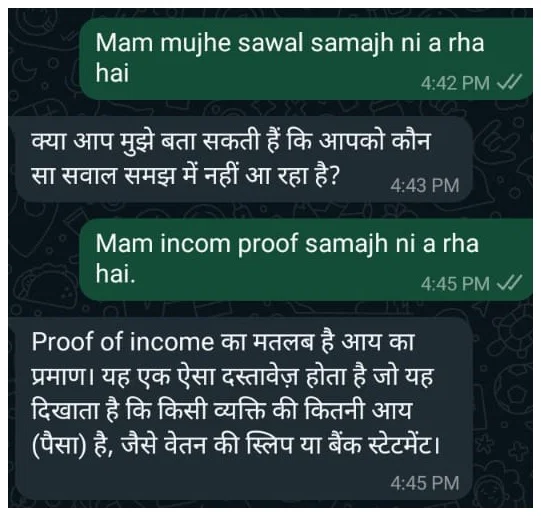
There is a screenshot from the Milaan Chatbot that is easy to overlook. The conversation is happening on WhatsApp, against that familiar pale wallpaper of speech bubbles and tiny line drawings. A girl has been answering questions about a scholarship. The chatbot asks why she has not applied. There are buttons to choose from. The exchange is orderly, the way digital journeys are designed to be orderly.
Then she types:
“Mam mujhe sawal samajh ni a rha hai.”
Ma’am, I don’t understand the question.
A little later, she tries to explain what has confused her.
“Mam incom proof samajh ni a rha hai.”
She does not understand what “income proof” means.
The chatbot explains that it is proof of how much money a person earns, giving examples such as a salary slip or bank statement.
It is a very small interaction. There is no dramatic moment in it, no technological spectacle. Just a young person encountering a phrase that belongs to the language of forms and institutions, and asking someone—or in this case, something—to explain it in words she understands.
But perhaps this is exactly where the story should begin. Because information can be available everywhere and still remain far away.
A government scheme can have a website, a notification, a portal, a set of eligibility criteria and a list of documents. A scholarship can be announced in schools and circulated through WhatsApp groups. Technically, nothing is hidden.
Yet for a girl sitting in a village with a phone in her hand, access may come down to something much more ordinary: Does she understand the question? Does she know what document they are asking for? Can she tell whether she qualifies? Does she know what to do when the link does not open?
Sometimes the gap between an opportunity and the person it was designed for is only a few words wide.
Sometimes those few words are enough.
मुझे समझ नहीं आ रहा है।
I don’t understand.
In Kannada: ನನಗೆ ಅರ್ಥವಾಗುತ್ತಿಲ್ಲ.
The language changes. The hesitation does not. That hesitation—the space between information existing and information becoming usable—is one of the things Milaan has been trying to understand through its work with WhatsApp-based chatbots.
Knowing a scheme exists is only the beginning
Rukhsar (name changed), is an adolescent girl from Uttar Pradesh. She had already heard of the Mukhyamantri Kanya Sumangala Yojana, a government scheme that provides financial assistance to girls at different stages of their lives.
So awareness, in the broadest sense, was already there.
What was missing were the details that make awareness useful. She did not know the eligibility criteria, the documents she would need, how the different stages of assistance worked, or how to complete the application. Through the Milaan Chatbot, she was able to work through those questions one by one: income limits, domicile requirements, documents, bank details, birth certificates, the online form.
It is tempting to describe this as an information-delivery success. But what happened next is more interesting.
Rukhsar began sharing what she had learned with other girls. She helped her peers understand whether they were eligible and supported them as they filled out their own applications. The information did not stop with the person who first received it; it moved sideways, from one girl to another, through relationships that already existed.
“Earlier, I had only heard about the scheme, but I didn’t know the details. Through the Milaan Chatbot, I understood everything clearly. Now, I am also helping other girls apply and benefit from it.”
There is a transformation inside those words. She had heard about something. Then she understood it. Then she used that understanding to help somebody else. For an organisation that works with adolescent girls and thinks deeply about leadership, that progression is significant.
Leadership, especially at the grassroots, does not always arrive looking like leadership. It may look like one girl sitting beside another with a phone between them, saying, No, look, this is what they mean. This is the document you need. This is where you click.
Adults who design programs, portals and application processes often encounter information in its finished form. There is a scheme note, an eligibility table, a deadline, a form. Everything has its place. A young person meets the same system differently.
She encounters a sentence she has never seen before. A dropdown menu. A PDF that does not fit comfortably on a phone screen. A request for a certificate she does not recognise by name. A portal designed for somebody who already knows what they are looking for.
There is also a second layer that does not appear on any website. An adolescent girl may need access to the family phone. She may need to ask a parent for documents. She may have to travel somewhere. She may need permission. She may understand what an opportunity offers and still be unsure whether pursuing it is possible for her.
This is why simply making information available cannot be the end of the work.
For information to become useful, it has to move through several stages: a girl must discover that something exists, understand what it means, make sense of her options and then see a path towards action. In program language, those stages can be drawn neatly as Discover → Understand → Choose → Act.
In real life, of course, the arrows are rarely so tidy.
A familiar green screen
The decision to use WhatsApp was not born from a desire to build something futuristic. In fact, its value lies partly in the opposite. It is familiar.
For many users, there is no new interface to learn before the conversation can begin. No special app to download. No unfamiliar dashboard waiting behind a password. The information arrives in the same space where family messages, school updates, photographs and voice notes already arrive.
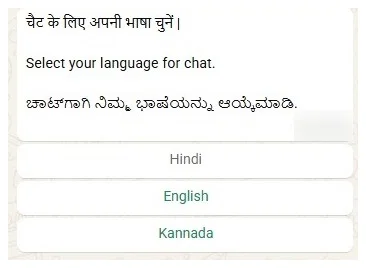
The Milaan Chatbot can currently be accessed in Hindi, English and Kannada. A conversation may therefore begin with perhaps the simplest choice a digital service can offer: How would you like to speak?
Hindi. English. Kannada.
From there, a girl can move through buttons and quick replies, read about opportunities, check eligibility, see which documents are needed and ask a question when the prepared pathway no longer matches the question in her head.
There is something revealing in the screenshots.
At first the chatbot looks almost bureaucratically neat. Interested / Not Interested. Then Eligible / Not Eligible. Then comes a list of documents, followed by three steps explaining how to apply.
And then the human being appears.
Document kya kya chahiye?
What documents do I need?
Or the earlier message:
I don’t understand.
People rarely speak in the vocabulary of program design. They type quickly. They mix languages. They spell words the way they hear them. They begin a question without knowing exactly how to finish it.
The system has to meet them there.
Across Milaan’s wider chatbot ecosystem, more than 93,000 adolescents and users have now been reached. It is a substantial number, but the number alone tells us relatively little about whether a digital tool is useful.The more interesting material lies inside those thousands of interactions: the points where users pause, the questions they ask twice, the messages they abandon, the words that need explaining.
What do girls actually want to know? At what point does an application begin to feel difficult? Does a paragraph help, or does it simply add more text to a crowded screen? Would a short video make something clearer? What do we, as program designers, think is obvious only because we already know how the system works?
Those questions have changed the chatbot over time.
It began with a stronger focus on scholarships. Conversations and focus group discussions with adolescents showed that girls were also looking for career guidance, which led to the addition of career-related content. Testing also showed that text-heavy messages were not always the best way to hold attention or explain a process. Buttons, quizzes and quick replies were introduced, while video tutorials featuring Milaan alumni helped make application processes easier to follow.
The chatbot also made certain gaps more visible to program teams. It became possible to see who had heard about an opportunity, who had applied, where someone dropped out and where additional support might be needed. That changes the role of the technology slightly. It is no longer only a channel through which information travels outward. It can also become a way of listening to what comes back.
The Kanya Sumangala experience offers one example. Through chatbot-enabled outreach, more than 4,000 girls became aware of the scheme, while 300+ successfully applied with support from the Milaan Chatbot. Those numbers relate to this particular intervention; they are not the same as the 93,000+ people reached through Milaan’s wider chatbot ecosystem.
And even here, the applications are only the visible end of a longer process.
Before an application there may have been a girl who had to find her Aadhaar details. Someone who had to ask for an income certificate. Someone whose link would not open. Someone who began the process, stopped, asked a question and tried again.
Digital systems often count the final click. The human story is everything that happened before it.
When AI enters the room
Artificial intelligence came later in Milaan’s chatbot journey, and it is worth keeping it in that order.
The original question was never, How can we use AI? It was, How can adolescent girls get information they can actually understand and use?
AI became relevant because structured journeys have limits. A button can anticipate a set of answers. A person, thankfully, cannot always be reduced to them.
Young users ask questions in their own language, in unexpected ways and sometimes about things no one anticipated when the flow was designed. Milaan therefore began testing AI, including GPT-4o, within parts of the chatbot experience.
The experiment quickly surfaced a useful caution.
When the AI was more open-ended, users sometimes asked unrelated questions. That prompted a shift away from unrestricted responses towards document-based, verified information.
A young person may begin with a scholarship question and move towards something personal, medical or risky. A fluent response is not necessarily a responsible one. In Milaan’s testing, prompts were designed to avoid giving direct medical advice or medicine names for certain sensitive queries and instead direct a user towards a health centre or doctor. The team also ensured that personal user data was not shared with the AI during this testing.
These choices do not mean the difficult questions around AI and adolescents have been solved. Far from it. Privacy, verification, language, bias, uncertainty, safeguarding and escalation all require continued scrutiny.
But perhaps there is a useful principle here. For adolescent-facing technology, intelligence may have as much to do with restraint as with fluency.
Sometimes the best response is an explanation. Sometimes it is a question. Sometimes it is: Please speak to someone who can help you with this.
What happens after the phone is put away?
For Milaan, the chatbot can never be the whole story because the lives of the girls we work with do not exist inside a screen.
They unfold in homes and schools, in villages, Anganwadi centres and community spaces. They are shaped by peers, parents, Girl Icons, teachers, frontline workers, local institutions and public systems.
A chatbot may tell a girl what document she needs, but someone may still have to help her obtain it. It may explain an entitlement, but a conversation at home may determine whether she can pursue it. It may point towards an application, while a Girl Icon, Anganwadi worker or another trusted person helps her navigate what happens next.
This human infrastructure is not something technology should aspire to replace. It is what gives the technology meaning.
Milaan has set an ambition to reach 2 million adolescent girl leaders by 2030. Inevitably, that raises questions about scale: how information travels, how girls continue to receive useful support as programs grow, and how technology might make some forms of knowledge easier to reach without making the work itself more distant.
But perhaps the more important question is what kind of scale we want. If a girl learns something and the knowledge stays with her, that matters. If she uses it to make a decision, it matters more. If she then turns to another girl and says, I know how this works; let me show you, something else has happened.
Rukhsar’s story is modest in scale compared with a figure like two million. One girl learns about a scheme. She understands the requirements. She helps another girl fill out a form.
Yet this is precisely the kind of movement Milaan means when it speaks about girl leadership: knowledge becoming confidence, confidence becoming action, and action travelling through relationships.
Eventually every chatbot conversation ends.
The phone is set down. The light on the screen disappears. The little ticks beside the last message turn blue, or perhaps they do not.
What matters next cannot be seen on the interface. Does the girl gather her documents? Does she talk to her mother? Does she ask an Anganwadi worker for help? Does she return to the application she had abandoned? Does she decide that this particular opportunity is not for her? Does she forward the information to a friend? Perhaps she sits beside another girl the following afternoon, phone balanced between them, and explains a word that confused her only the day before.
A digital tool cannot make that decision for her. It should not. At its best, it can make the distance between I have heard about this and I know what I can do next a little shorter. Because information is not powerful merely because it has been published, uploaded or sent. It becomes powerful when someone can make sense of it, question it, use it and carry it further.
And sometimes that journey begins with the most ordinary sentence imaginable:
I don’t understand.